

289 The Late Discovery: Unlearning Man’s Path to Find God’s
On Finding Faith After Fifty and the Burden of Unseen Yokes

Good morning, and hello friends.
This morning, as I sipped my tea and listened to the birds chirping from mom’s mango tree in the front yard, a message from a reader settled into my spirit. It was a message about duty, obligations, failure, about paths, and about the weight we carry without knowing it. As a result of that message, I began to reflect on the pros and cons of not discovering Yahuah until you’re in your fifties, as opposed to growing up in the church, knowing Him, and being surrounded by a family that did the same.
Before I wade into those waters, I think it’s only fair, especially for those of you new to this journey…to tell you where I’m standing. I need to explain my own history with what I will intentionally call “religion.” Because for the longest time, that’s all it was. It had nothing to do with faith.
My parents were Catholic. They raised my sisters and I Catholic. We observed all the Catholic holidays, attended Catholic schools through high school, and participated in all the rituals: Baptism, First Communion, Confirmation, weekly confessions. The whole procession.
For us kids, it meant someone, my parents, an aunt, an uncle, made sure we got to Sunday service every week. My parents always worked multiple jobs, including weekends, so the duty was often delegated. As for my parents themselves, they made it to church on special occasions: Christmas Eve, maybe a New Year’s midnight mass, Easter, Ash Wednesday. All told, they might be in a pew six to twelve times a year.
Did we know Bible stories? Some. The popular ones: Moses, Noah’s Ark, the birth of Jesus. We knew them not from family Bible reading, but because we saw the movies.
So, as you can imagine, we grew up, went into the world, and for the most part, the “going to church” part of our religion fell by the wayside. One of my sisters became an ardent atheist, a secret she keeps from my parents to this day. The other repeated the pattern with her own kids: dropping them at Sunday mass, sending them to Catholic school, attending herself only for the main events.
And me? My motto for decades was this: I don’t know anything about God, but I’ll do “my best,” just in case He’s real and there are ramifications someday. My hail mary hope was that I’d get a few minutes to confess and repent before taking my last breath. In practice, this meant I, too, would go to mass a few times a year, not on crowded holidays, but on a random Tuesday at 10 a.m. because my spirit felt thin and called for it, or at a 5 a.m. weekday service back when parishes had them. I self-identified as a Catholic not out of conviction, but because it was the only thing I knew. The architecture was nice, too. And that was my “religion” until I turned fifty-one.
Now, let me contrast that with a different history. There are families where parents grew up in the church, involved in ministries. Their children are raised the same way. They are taught what’s in the Bible by the professionals on stage each Sunday, though some go deeper with home readings. The outcomes vary: some become church leaders, others remain on the periphery, a few reject it all and walk away. I’ve seen this pattern across all religions: Christianity, Judaism, Islam, the Anabaptist traditions, Latter-day Saints, Jehovah’s Witnesses and so on.
As I’ve observed, people get older, life slows down, and many find their way back into some form of “religion.” I’ll call this Stage Two religious life. That’s where I am. It’s where my parents are.
So this analysis generally works with these two frameworks: “Religion Stage One” and “Religion Stage Two.” More specifically, I’m comparing someone like me, with minimal spiritual maturity and only vague doctrinal convictions growing up, to someone who had spiritual awareness and a specific religious indoctrination from childhood.
To be clear, if you’re a Gen Xer like me, you’ve been indoctrinated to some degree even if you never set foot in a church. We all have. We are subconsciously shaped by the people around us, the media we consume, and the cultural water we’ve swum in for fifty years.
In Stage Two, by God’s grace and the Holy Spirit’s guidance, some of us reach a point where these man-made doctrines are exposed for what they are. But this doesn’t happen to everyone. Some in Stage Two become even more entrenched in those doctrines. You might wonder, “Why does God allow that?” I’ve asked that, too. I don’t have the answer.
But the Holy Spirit did force me out of my proverbial “Christian” closet early on. He instructed me to visit several local churches. Some, I attended once, and He firmly said, “Enough.” A few, He had me attend for weeks or even months. Then, He made it clear: I had seen all I needed to see in those brick-and-mortar places. For now, my instruction is to abstain.
These days, my faith community exists online: a few Bible groups and Zoom calls each week. This Substack, and the ones I read from all of you, has become a central part of my walk. My community is global, filled with faces I’ve never met in person. My guide is the Holy Spirit. My priest is Yahusha. My Creator is Yahuah, the God of Abraham, Isaac, and Jacob.
Okay, I’m finally arriving at the point. Thank you for your patience.
The pros and cons of minimal religious indoctrination versus substantial religious indoctrination. The core difference, as I see it, is the amount of unlearning required. The programming we receive (consciously or subconsciously) influences how we behave. Often, we are blind to how these man-made doctrines shape us, creating distance from the Holy Spirit. They become yokes, as one of you readers pointed out to inspire this article, yokes Yahuah never asked us to carry. Our failure to bear these false burdens leads to guilt, shame, and contempt, which stifle our growth and make us feel separated from our Father. That separation, of course, is the enemy’s ultimate goal.
I was in the “minimal indoctrination” camp, and even I have had to unlearn so much. I can only imagine how much stickier and more integrated these behaviors are for someone raised deep within a religious system.
I don’t pretend to have a fix-all solution. But I can share what is working for me.
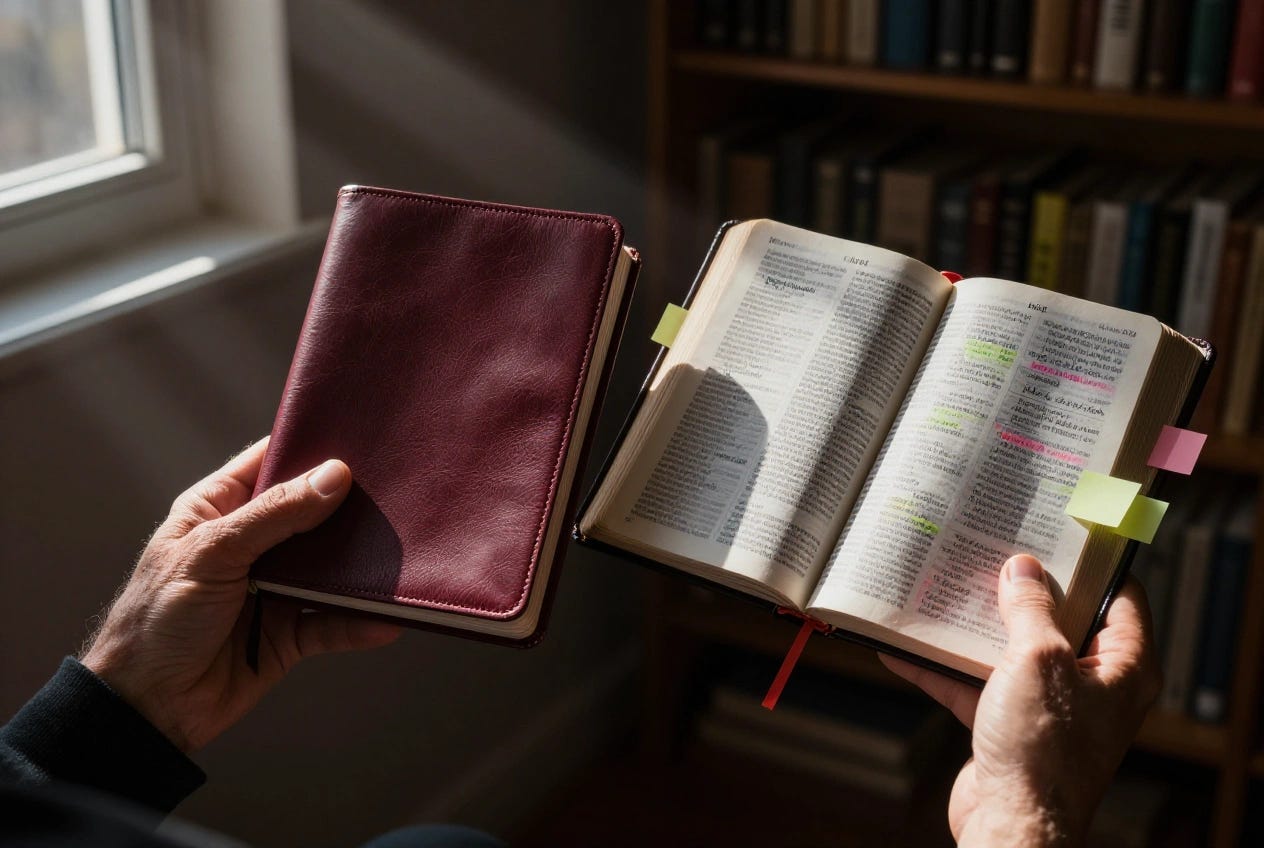
I began reading my Bible from page one, book one. I approached it as a child, knowing none of the characters and presuming nothing about how any story, book, passage, or parable would end. I read a little each day, then prayed and meditated (my Midnight Walks with Wiggles) on it. Some days, I’d get through chapters; other days, just a few verses. And that’s okay.
What started happening was the Holy Spirit guiding me to specific passages, books, and chapters, sometimes out of sequence (more to come on this in a future article). I’d follow that lead, then return to where I’d left off. This is how I ended up reading four different Bibles concurrently. The process is slow. I’ve been at it for almost two years now. I am no scholar, but this practice has been instrumental in helping me distinguish between man-made religious stuff and what Scripture actually says.
Let me be clear: you don’t need multiple Bibles, a pastor, a church, or a pope for any of this. You need a Bible (freely available), prioritized time to be still with the Lord, and regular time set aside for reading Scripture. That’s it.
This direct, unmediated encounter with the Word is how we shed the empire’s labels and embrace our true identity in Christ, as I wrote about in “Set Apart: The Sacred Distinction of a Walker in the Way.” It’s how we learn to tend our own garden with the Spirit, as in “The Garden We Tend Together.” It is the most direct path I’ve found to silence the noise of human tradition and hear the Father’s heart.
The “pro” of coming to faith late, with little prior indoctrination, is that there’s less to unlearn. You’re not fighting years of layered interpretation. The “con” is you start with a vacuum, a lack of foundational Bible knowledge that others have had for decades. You feel behind.
The “pro” of growing up in faith is that foundation. The “con” is that the faith you know may be so intertwined with human tradition, culture, and empire that separating the voice of God from the noise of man becomes the work of a lifetime. The yoke feels familiar, even if it’s not His.
In the end, our starting point matters less than our direction. Whether you’re deconstructing a lifetime of religion or constructing a faith from scratch at fifty-one, the destination is the same: a direct, personal, obedient relationship with Yahuah, through Yahusha, guided by the Spirit. It’s about finding the narrow path He has for you and walking it, one trusting step at a time.
That is all, and thank you for reading.
From The Archives


If you enjoy Faith In The Fast Lane, I would be incredibly grateful for your support. Consider using one or more of the links below.
You can also find me on other social media platforms using the below links.
On X (formerly Twitter) : Shashue Monrauch on X
On YouTube: Shashue Monrauch on YouTube
On Instagram: Shashue Monrauch on IG
On NOSTR:
Shashue npub1ldn7g28j6rc49gmmyh2yk4z8y688hhuuzgs2v5q2erz784cegshs6427d0
Thanks for your time and support.
Shashue Monrauch