

293 The Front Porch Lesson: Why Yahuah’s Sharpest Corrections Save Us
On Training Dogs, Silencing Priests, and the Imprint of Holy Discipline

Good morning, and hello friends.
Today I want to compare my relationship with my dog Wiggles to the relationship between Yahuah and Zechariah. I know that sounds like a stretch. But stay with me. The Holy Spirit has been pressing this connection into my spirit for days now, and I need to get it out.
Let me start with the passage that started all this.
Luke 1:18-20 (ESV)
“And Zechariah said to the angel, ‘How shall I know this? For I am an old man, and my wife is advanced in years.’ And the angel answered him, ‘I am Gabriel. I stand in the presence of God, and I was sent to speak to you and to bring you this good news. And behold, you will be silent and unable to speak until the day that these things take place, because you did not believe my words, which will be fulfilled in their time.’”
Then, after John is born and named, Zechariah’s speech is restored:
Luke 1:64 (ESV)
“And immediately his mouth was opened and his tongue loosed, and he spoke, blessing God.”
A vow of silence. Nine months of it. Because Zechariah doubted the promise of God delivered by the mouth of Gabriel.
Now let me tell you about Wiggles.
Wiggles is a six year old Cane Corso. That is an Italian mastiff breed. She starts out like most puppies: blind, completely dependent on her mother and the cutest thing on God’s given earth for the first few months. Over the next six to eight weeks, she learns exclusively through her relationship with mom and her litter mates. If you are fortunate enough to become a handler for this breed as a pup, your first and most important objective is to bond and establish trust. The strength of that bond in the first six to eight months is critical. Because in less than three years, this pup will be more agile, stronger, and capable of inflicting harm than you as its handler in some situations. The initial objective above all else is trust and faith.
You teach the young pup: when you do the things I like, you will be rewarded. When you do the things that grieve me, you will have no rewards, but in some cases there will be different severities of correction and negative consequence.
For the first two years, I test and stretch that trust and faith. I ask my pup to do things in the most inopportune times. I place her bowl of food before her and ask her to wait before it as I wash dishes, do my exercise, or sweep the floors. She waits even with my back turned. She does this because she knows she can trust me. When she demonstrates that trust, she is rewarded.
Her instinctive prey drive will hone in on the skunk on the trail before us. She wants to charge it out of curiosity or fear. I give her a “leave it” and a “heel” command. She observes the skunk beside me from a distance, knowing once again that she has pleased me.
These minor drills, as we call them in canine training and behavior, may need to be repeated often until they can be relied upon one hundred percent of the time.
Now contrast that with a different type of approach.
I want to establish a new behavior with Wiggles. I want her to never set foot off the front porch unless I have given her explicit permission to do so. I understand the consequences of her stepping off the porch in real life: she chases a squirrel across the street, gets hit by a bus, and is killed.
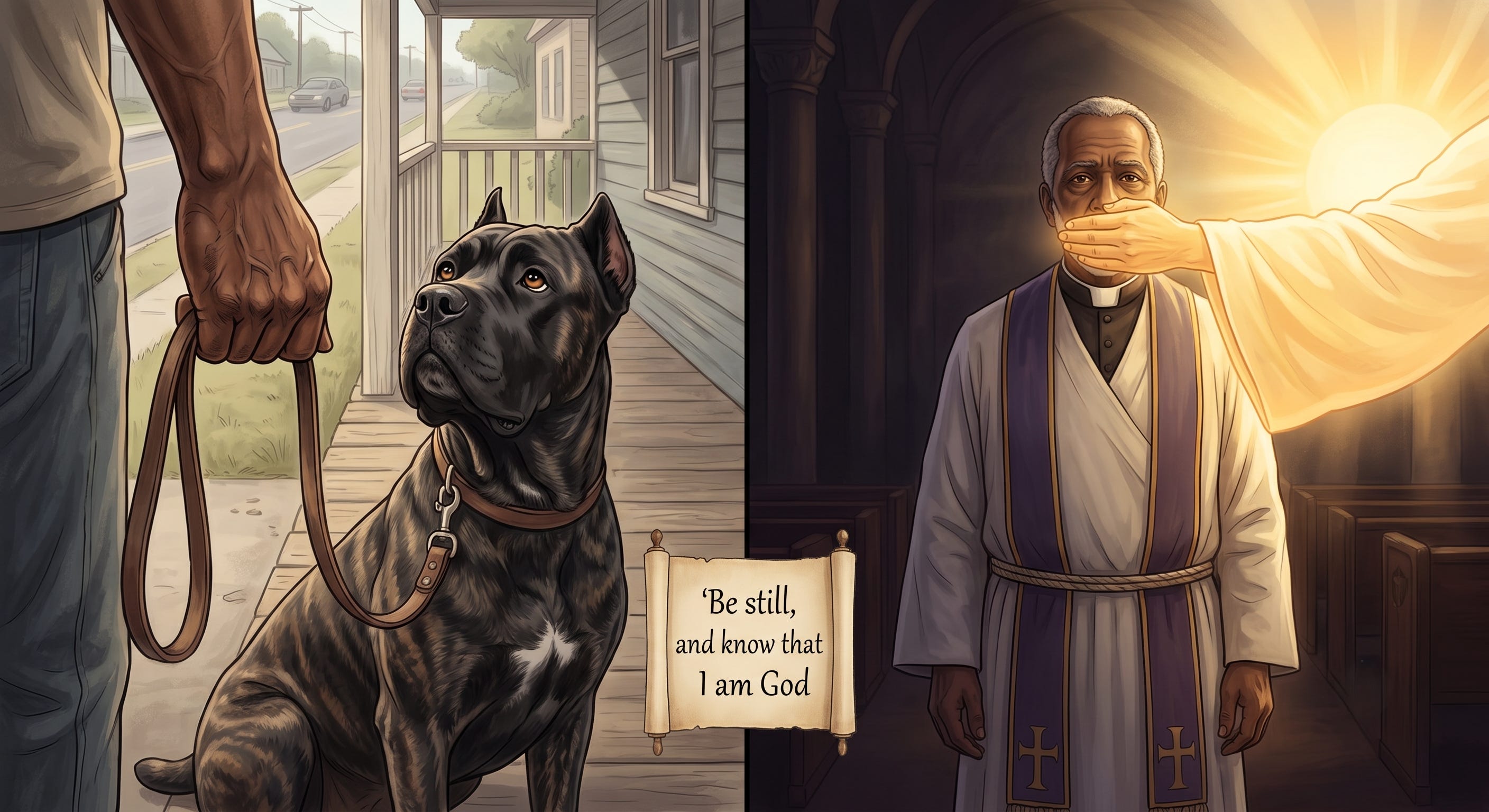
As her handler, I understand this is a life and death scenario. But to a six month old Wiggles, she may think, “Dad is being mean for not allowing me to chase that squirrel, because when we are in the woods he gives me the command to chase squirrels and chipmunks.”
In this scenario, I need her to distinguish between chasing squirrels in the woods or fenced backyard and chasing squirrels from the open porch.
So I position her on the front porch with a “stay” command on an early Sunday morning before the neighborhood wakes up and traffic picks up on our street. I leave her there, go in the house, and discretely observe from the living room.
Sure enough, she inevitably sights the neighborhood squirrels galavanting across the street and on the sidewalk just yards from her. Her prey drive compels her to step off the porch to pursue the closest squirrel.
Watching from the house, I interrupt her transgression in an exaggerated, overly dramatic form. She is shocked and overwhelmed in more ways than one. She is confused about my reaction, what caused my reaction, and in that moment she is imprinted for life with this specific scenario. I will perform several drills of the same type at different times over the next few months. But she will never repeat that initial offense. She learned from the very first instance: a “stay” command on the front porch means never ever set foot off the front porch without an explicit command to do so.
One correction. One imprint. One lesson that saved her life.
Now, how does this tie back to Zechariah?
God wanted Gabriel to teach Zechariah to have faith and trust in Yahuah. God set up a scenario that would ensure Zechariah learned this in a deeply imprinted way. Gabriel, Yahuah’s messenger, could have spoken a thousand word lesson to Zechariah about faith and trust in the Lord. That might have worked over time with repetitions and reminders. But angels are busy beings. Unlike God, they are not omnipresent. So Gabriel used the front porch method.
He struck Zechariah mute.
Nine months of silence. Nine months of replaying that moment in the temple. Nine months of watching his wife Elizabeth’s belly grow, a living testimony that the promise was true. Every time Zechariah wanted to speak, he could not. Every time he wanted to explain himself, to justify his doubt, to tell someone about the angel, he was reminded that his words failed him because his faith had failed first.
I am certain Zechariah learned the lesson deeply within the first few days, if not hours. But the silence lasted nine months. Why? Because the lesson needed to be fully formed. The imprint needed to set. And during those nine months, Gabriel was free to go out and handle other Kingdom business, knowing that Zechariah was being taught to remember and be mindful of his trust and faith in the Lord.
The sharpness of the correction matched the depth of the lesson.
Now, here is the point of this article.
The most painful experiences we endure are the ones that imprint us the deepest. And often, those are the experiences that are eternally life saving, even though we may not realize it in the moment. We may think our Father has abandoned us, that He is upset with us, that He is being unfair. But in actuality, He understands precisely the challenge we need to learn the specific thing He wants us to learn. The thing that will ultimately bring us closer to Him.
Think about it. Wiggles did not understand why I was so dramatic about the porch. She only knew that stepping off the porch resulted in something terrible. She did not know about buses. She did not know about traffic. She only knew that her handler’s reaction was severe, and she never wanted to experience that again. The correction saved her life, even though she could not comprehend the danger.
Zechariah did not understand why his doubt warranted such a severe response. He was a righteous priest. He served faithfully. He and Elizabeth were blameless before the Lord. But in that moment, he doubted the direct word of God delivered by Gabriel. That doubt needed to be addressed at the root. Not because God was angry, but because Zechariah was about to become the father of the prophet who would prepare the way for the Messiah. If Zechariah carried even a seed of doubt into that calling, the entire mission could be compromised.
The silence was not punishment. It was protection. It was preparation. It was imprinting.
Hebrews 12:5-6 (ESV)
“And have you forgotten the exhortation that addresses you as sons? ‘My son, do not regard lightly the discipline of the Lord, nor be weary when reproved by him. For the Lord disciplines the one he loves, and chastises every son whom he receives.’”
Discipline is not rejection. It is love. It is the mark of sonship. The father who does not correct his child does not care about the child’s future. The handler who does not correct the dog is setting the dog up for disaster.
Now look at what happened after Zechariah’s silence ended.
Luke 1:67-79 (ESV)
“And his father Zechariah was filled with the Holy Spirit and prophesied, saying, ‘Blessed be the Lord God of Israel, for he has visited and redeemed his people and has raised up a horn of salvation for us in the house of his servant David, as he spoke by the mouth of his holy prophets from of old, that we should be saved from our enemies and from the hand of all who hate us; to show the mercy promised to our fathers and to remember his holy covenant, the oath that he swore to our father Abraham, to grant us that we, being delivered from the hand of our enemies, might serve him without fear, in holiness and righteousness before him all our days. And you, child, will be called the prophet of the Most High; for you will go before the Lord to prepare his ways, to give knowledge of salvation to his people in the forgiveness of their sins, because of the tender mercy of our God, whereby the sunrise shall visit us from on high to give light to those who sit in darkness and in the shadow of death, to guide our feet into the way of peace.’”
His first words after nine months of silence were not about himself. They were not complaints. They were not questions. They were praise. They were prophecy. They were the words of a man who had been imprinted with the deepest lesson of trust.
Zechariah’s silence ended in worship. That is what happens when we submit to the Father’s training. That is what happens when we allow the sharp corrections to do their work.
I think about the centurion in Luke 7. He understood authority. He said to Yahusha, “But say the word, and let my servant be healed. For I too am a man set under authority, with soldiers under me: and I say to one, ‘Go,’ and he goes; and to another, ‘Come,’ and he comes; and to my servant, ‘Do this,’ and he does it” (Luke 7:7-8, ESV). Yahusha marveled at him. He said, “I tell you, not even in Israel have I found such faith” (Luke 7:9, ESV).
The centurion understood that a word from the Master was enough. He did not need Yahusha to come to his house. He did not need a sign. He understood authority because he lived under it and exercised it. That is the kind of faith that comes from training. That is the kind of faith that comes from being imprinted.
And then there is the woman in Luke 7 who washed Yahusha’s feet with her tears and wiped them with her hair. She was a sinner. She had much to be forgiven. And because she understood the depth of her debt and the magnitude of the forgiveness, she loved much. Yahusha said to her, “Your faith has saved you; go in peace” (Luke 7:50, ESV).
Her faith was not perfect. Her past was not clean. But she understood something that Simon the Pharisee did not: she knew she needed a Savior. And that knowledge came from the sharp corrections of her own life.
So what does this mean for us?
It means that when the trial comes, when the silence descends, when the correction feels overwhelming, we need to recognize what is happening. Yahuah is not punishing us. He is training us. He is imprinting a lesson into our spirits that will save our lives, possibly our eternal lives.
The sharper the correction, the faster we learn it. The more deeply it becomes imprinted. And the more we will praise Him when the silence ends.
I have been through my own front porch moments. Times when the Holy Spirit shut my mouth, closed my doors, stripped my resources, and left me sitting in the silence. I thought He had abandoned me. I thought I had done something wrong. But He was teaching me to trust Him. He was teaching me that His promises do not depend on my doubt. He was teaching me that a word from Him is enough.
And when the silence broke, I spoke blessing. I spoke praise. I spoke of His faithfulness, not my struggles.
That is the goal. That is the destination. The front porch lesson is not meant to break us. It is meant to build us. It is meant to imprint us with the kind of trust that does not waver when the squirrel runs across the street.
Proverbs 3:11-12 (ESV)
“My son, do not despise the Lord’s discipline or be weary of his reproof, for the Lord reproves him whom he loves, as a father the son in whom he delights.”
Wiggles does not despise me for the front porch correction. She loves me more because she knows I keep her safe. Zechariah did not despise Gabriel or His God for the silence. He praised God when it ended. And we, when we come through the fire, will not despise the Refiner. We will thank Him for making us into vessels that can hold His glory.
That is all, and thank you for reading.
If you enjoy Faith In The Fast Lane, I would be incredibly grateful for your support. Consider using one or more of the links below.
You can also find me on other social media platforms using the below links.
On X (formerly Twitter) : Shashue Monrauch on X
On YouTube: Shashue Monrauch on YouTube
On Instagram: Shashue Monrauch on IG
On NOSTR:
Shashue npub1ldn7g28j6rc49gmmyh2yk4z8y688hhuuzgs2v5q2erz784cegshs6427d0
Thanks for your time and support.
Shashue Monrauch