

274 The Master’s Plan, The Son’s Missions
From Lamb of Sacrifice to Lion of Judgment, Why We Must Know the Whole Messiah

Good morning, and hello friends.
I want to talk with you today about a fracture in our understanding, a crack that runs right through the heart of how many of us see God. It’s the idea, so common now in 2026, that the God of the Old Testament is somehow a different being than the God of the New. One is portrayed as a God of wrath, of rules, of judgment…mean, distant, and harsh. The other is seen as a God of grace, of love, of forgiveness…sweet, approachable, and kind. We’ve created a divine split personality, preferring the Son over the Father, as if the Son came to correct the Father’s mistakes.
This isn’t just a theological error. It’s a spiritual blindness with dangerous consequences. It arises from a fundamental confusion of the order between the Father and the Son, and a loss of understanding about the distinct missions the Master has given His Son. We love to talk about Yahusha as our Savior. We bask in that grace. But we rarely, if ever, acknowledge with the same fervor that this same Yahusha, authorized by His Father, is also our Judge.
Let’s walk through this together. Let’s lay aside what culture tells us and look at the story the scriptures are telling. It’s a story of one God, one plan, and two world-altering missions carried out by the same beloved Son.
The Father’s Heart and the Sent Son
To untangle this, we must start at the beginning, with the Father. Yahuah, the great I AM, the God of Abraham, Isaac, and Jacob, is not a moody deity who changed His mind between Malachi and Matthew. His character is consistent: holy, just, merciful, and abounding in steadfast love.
The problem was never with the Father’s nature; it was with our ability to live up to His holy standard. The law revealed His character and our brokenness. The prophets cried out for a solution. And the Father’s answer was always His Son.
The Master sent His Son the first time with a very specific, focused mission. It was a mission defined by the vocabulary of redemption: to serve, to teach, to forgive, to love, to be the suffering servant. Yahusha said it plainly: “For the Son of Man came not to be served but to serve, and to give his life as a ransom for many” (Mark 10:45, ESV). He came to be the Lamb of God who takes away the sin of the world (John 1:29). His “rules of engagement” for this mission were humility, compassion, and self-sacrifice. He turned the other cheek.
Yahusha came to earth the first time through the womb of a virgin, lived in relative obscurity for 30 years, doing human things and eventually stepped on the stage for His final three years. But scripture tells us He returns the second time in a very different manner and “style”, if you will.
On His first assignment, he prayed for His persecutors. He allowed Himself to be mocked, tortured, and crucified. Why? To fulfill the Father’s will to redeem a people for Himself. He was the perfect Executor of the Father’s saving plan.
This is the Yahusha we know and love. This is the image we cling to. And it is right and good to do so.
The Great Irony of Expectations
Here is where history gives us a piercing irony. When Yahusha came the first time, the Jewish people, living under the severe thumb of Roman oppression, were reading the same prophetic scriptures we have. They saw the promises of a conquering King from David’s line, a Messiah who would break the rods of their oppressors. They were expecting the Warrior-King, the Judge who would bring deliverance through power and might.
Instead, they got a “hippie” from Nazareth. A man who talked of loving enemies, of a kingdom not of this world, who rode a donkey instead of a warhorse. They expected the Lion of Judah; they got the Lamb who goes silently to the slaughter. They were looking for the mission of judgment and were confounded by the mission of salvation. Many rejected Him because He did not fit their expectation.
Now, flip the script to our day. We have fully embraced the Lamb. Our modern theology, our worship songs, our preaching often present only the Savior of unconditional acceptance. We have created a Jesus in our own image…always gentle, always affirming, never confronting. We expect, if we think of His return at all, this same gentle rabbi coming back. We are utterly unprepared, just as the first-century Jews were, but for the opposite reason. We expect the Savior; He is returning as the Judge.
We have taken the first mission and assumed it is His only disposition. We have comforted ourselves with half a Messiah.
The Second Mission: To Judge and to Reign
But the scripture is unblinkingly clear about the Son’s return. The Father, who sent Him first to save, will send Him again with a different mission. “And he [the Father] has given him [the Son] authority to execute judgment, because he is the Son of Man” (John 5:27, ESV). Paul stood in Athens and declared, “[God] has fixed a day on which he will judge the world in righteousness by a man whom he has appointed; and of this he has given assurance to all by raising him from the dead” (Acts 17:31, ESV).
The book of Revelation unveils this Judge in terrifyingly glorious detail. This is not the meek Yahusha of Galilee. This is the glorified Son of Man, the Faithful and True Witness, the King of kings.
“Then I saw heaven opened, and behold, a white horse! The one sitting on it is called Faithful and True, and in righteousness he judges and makes war. His eyes are like a flame of fire… From his mouth comes a sharp sword with which to strike down the nations, and he will rule them with a rod of iron. He will tread the winepress of the fury of the wrath of God the Almighty.” (Revelation 19:11-15, ESV)
His eyes like a flame of fire see through every pretense, every hidden sin, every secret act of faithfulness. The sword from His mouth is His word, the same word that said, “Let there be light,” the same word that said, “Your sins are forgiven.” That word will execute perfect, final justice. The time for pleading, for mercy extended through His sacrifice, will be past. The time for settling accounts will have come.
This is not a different God. This is not a Son who has overruled a cranky Father. This is the same Son, perfectly executing the second phase of the Father’s single, holy plan. The Lamb who was slain is worthy to take the scroll and open its seals (Revelation 5:9). The One who submitted to death is the One to whom the Father has given all authority to judge the living and the dead.
The Demand of Love: Obedience
This brings us to the heart of the matter: love. We forget that God desires willingly given love. And love, in His economy, is not a fuzzy feeling. It is allegiance. It is obedience. Yahusha Himself said, “If you love me, you will keep my commandments” (John 14:15, ESV). And again, “Whoever has my commandments and keeps them, he it is who loves me” (John 14:21, ESV).
He wasn’t speaking of a new, relaxed list. He was referring to the spirit and intent of the Father’s instructions…the law written on our hearts by the New Covenant (Jeremiah 31:33). All of them. The ones about loving Him with all our heart, soul, and mind, and loving our neighbor as ourselves (Matthew 22:37-40). This is how we show Yahuah we love Him. Not just in sentimental words or intellectual knowledge of texts, but in the doing. In the way we live with one another. In how we obey Him.
The gentle Savior of the first coming was not morally permissive. He raised the standard of the law to its true, heart-level intent (Matthew 5:21-48). He called for radical obedience, for a righteousness that exceeds that of the scribes and Pharisees (Matthew 5:20). The Judge of the second coming will assess our lives by this very standard. He will separate the sheep from the goats based on acts of mercy done to “the least of these” (Matthew 25:31-46). He will test the quality of each person’s work with fire (1 Corinthians 3:13).
The parable of the minas in Luke 19 is a stark picture of this. The nobleman (Yahusha) goes away to receive a kingdom. To his servants, he gives resources and says, “Engage in business until I come” (Luke 19:13, ESV). When he returns, he rewards the faithful servants who multiplied what was entrusted to them. But to the wicked servant who hid his mina out of fear, saying, “I was afraid of you, because you are a severe man. You take what you did not deposit, and reap what you did not sow,” the master replies, “I will condemn you with your own words” (Luke 19:21-22, ESV). And his judgment is severe. Furthermore, for the citizens who said, “We do not want this man to reign over us,” the command is, “Bring them here and slaughter them before me” (Luke 19:27, ESV).
This is the same Yahusha. The one who extends grace now will dispense justice then. His patience in this age is an invitation to repentance (2 Peter 3:9), not a license for lawlessness.
The Shaking and the Unshakable Kingdom
This is why the warning in Hebrews is so urgent: “See that you do not refuse him who is speaking… our God is a consuming fire” (Hebrews 12:25, 29, ESV). And, “Yet once more I will shake not only the earth but also the heavens… in order that the things that cannot be shaken may remain” (Hebrews 12:26-27, ESV).
Everything built on sand, on pride, on carnality (living by the fleshly nature), on love of self, money, and pleasure (2 Timothy 3:2-4)…will be shaken. Every kingdom, every institution, every life not founded on the Rock of hearing and doing His words (Luke 6:47-49) will suffer great ruin. The shaking is not random cruelty. It is the necessary, merciful removal of all that opposes the holy will of the Father so that His pure, unshakable Kingdom may be established.
We live in the tension between the two missions. We dwell in the grace of the first coming while the shadow of the second lengthens across our world. Our calling is not to terror, but to clear-eyed, sober-minded faithfulness. We are to build with gold, silver, and precious stones, the works of the Spirit, not with the wood, hay, and straw of the flesh (1 Corinthians 3:12). We are to move from carnality to spirituality, setting our minds on the things of the Spirit (Romans 8:5).
The Reward of the Faithful
Let me end not with fear, but with the happiest note imaginable for those who know and love God…not just in words, but in the obedient doing.
For the faithful servant, the one who has heard the Master’s words and built upon the Rock, the second coming is not a threat. It is the blessed hope, the glorious appearing (Titus 2:13). It is the moment when the King returns to say, “Well done, good and faithful servant. You have been faithful over a little; I will set you over much. Enter into the joy of your master” (Matthew 25:21, ESV).
It is the final rectification of all wrongs. The end of suffering, injustice, and evil. The wedding feast of the Lamb (Revelation 19:9). The restoration of all things. The wiping away of every tear (Revelation 21:4). It is the glorious fulfillment of the prayer Yahusha taught us: “Your kingdom come, your will be done, on earth as it is in heaven” (Matthew 6:10, ESV).
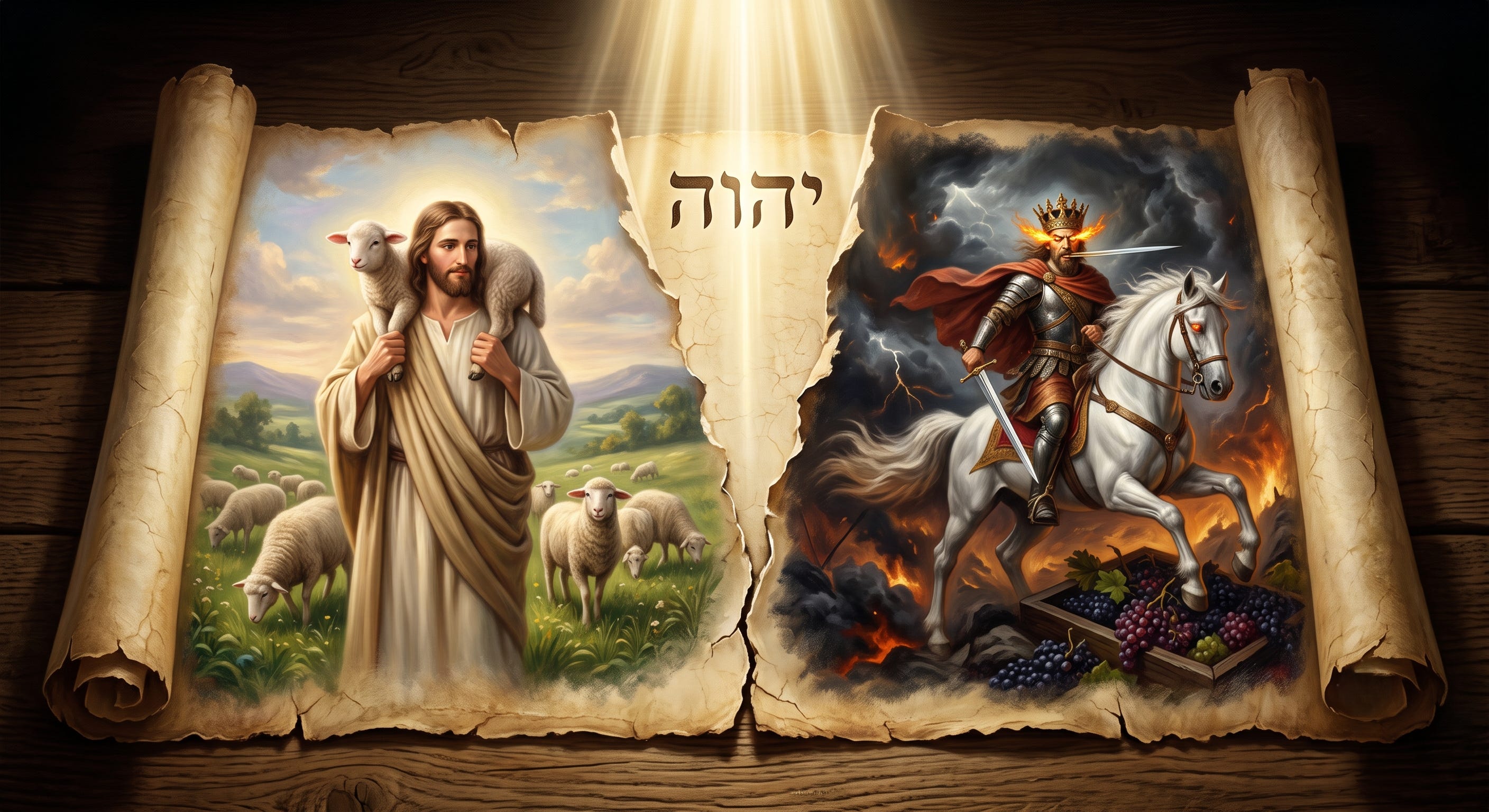
The Rider on the white horse, with eyes of fire and a sword from His mouth, is also the Bridegroom coming for His spotless Bride. His judgment purges the world of all that defiles so that the New Jerusalem, where righteousness dwells, can come down (2 Peter 3:13, Revelation 21:2). For the one who loves Him and keeps His commandments, this Judge is our Champion, our Vindicator, our coming King.
So, walk on, friends. Know the whole story. Worship the one true God…Father, Son, and Spirit…in the breathtaking fullness of who He is. Embrace the Savior who forgives you completely. Prepare for the Judge who will evaluate your life faithfully. Let your love for Him be proven by your obedience to Him. Build your life on the Rock of His words.
And when you see the signs of the times, the shaking that has begun, do not fear. Be grateful that you are receiving a kingdom that cannot be shaken (Hebrews 12:28). Offer to Yahuah the worship He truly desires: a life of reverence, awe, and willing obedience.
The Master sent His Son. He sent Him first to save us. He will send Him again to gather us, reward us, and reign with us forever. That is the good news, the whole, unshakable, glorious good news.
If Yahusha returned today to judge you, not your church, not your political party, not your religion, but you, where would you find yourself? This isn’t meant to scare you, but to make the future hope or warning…visceral and immediate. It’s a question I have to ask myself, too.
Would the gaze of those fiery eyes pass over you as wheat gathered into His barn, or would you be sorted out as a tare, fit only for the fire? Would the door to the wedding feast swing open for you, your lantern burning with the oil of faithful readiness, wick trimmed in expectation? Or would you be left outside in the darkness, your lamp empty and guttering out? When the Shepherd-King separates the nations, would you be placed on His right side with the sheep, or on His left with the goats?
These aren’t theoretical questions for a distant theology. They are the pressing, personal questions of a life built either on the rock of obedience or the sand of presumption. His return is the fixed point toward which all of history is moving. The only question that remains is: On which side of that line will I be found?
It all comes down to the condition of your heart today, revealed not by your words, but by your walk. “Not everyone who says to me, ‘Lord, Lord,’ will enter the kingdom of heaven, but the one who does the will of my Father who is in heaven” (Matthew 7:21, ESV).
“And Samuel said, “Has the LORD as great delight in burnt offerings and sacrifices, as in obeying the voice of the LORD? Behold, to obey is better than sacrifice, and to listen than the fat of rams. For rebellion is as the sin of divination, and presumption is as iniquity and idolatry. Because you have rejected the word of the LORD, he has also rejected you from being king.” (1 Samuel 15:22-23, ESV)”
That is all, and thank you for reading.
From The Archives


If you enjoy Faith In The Fast Lane, I would be incredibly grateful for your support. Consider using one or more of the links below.
You can also find me on other social media platforms using the below links.
On X (formerly Twitter) : Shashue Monrauch on X
On YouTube: Shashue Monrauch on YouTube
On Instagram: Shashue Monrauch on IG
On NOSTR:
Shashue npub1ldn7g28j6rc49gmmyh2yk4z8y688hhuuzgs2v5q2erz784cegshs6427d0
Thanks for your time and support.
Shashue Monrauch